
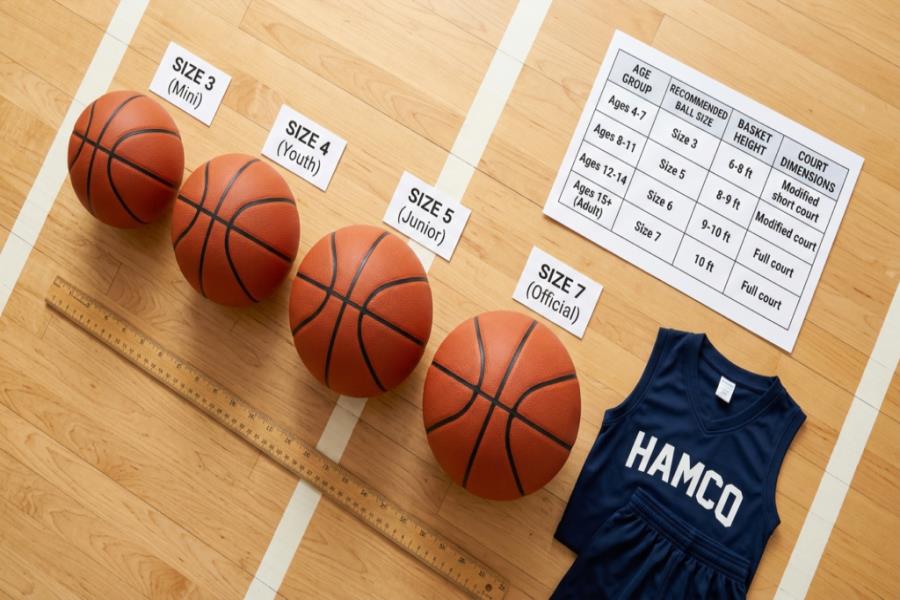
Youth basketball size equipment is determined primarily by age, league size and skill level. A size 5 basketball is the recommended size for many young players. The circumference is approximately 27.5 inches and the weight is approximately 17 ounces. It’s recommended that younger children play with smaller balls and older youth players can proceed to Sizes 6 or 7.
Many parents may not realize the crucial role of selecting the right ball. If the ball is too large or too heavy, it will be more difficult to dribble, pass and shoot. Using the right size ball helps children to have more control and concentrate on the fundamentals of learning to play.
Quick answer: youth basketball sizes by age
| Age Group | Recommended Size | Circumference | Approx. Weight |
| Ages 4–7 | Size 3 | 22 in | 10–12 oz |
| Ages 5–8 | Size 4 | 25.5 in | 14–16 oz |
| Ages 8–11 | Size 5 | 27.5 in | 17 oz |
| Ages 9–12 | Size 5 or 6 | 27.5–28.5 in | 17–20 oz |
| Ages 12+ | Size 6 or 7 | 28.5–29.5 in | 20–22 oz |
These are general guidelines. Youth leagues may have variations in specifications. Be sure to read the rules for the competition your child plays.
Youth Basketball Size Chart: What Each Size Means
Numbers are used to identify basketballs. The number indicates a general size and weight of the ball.
Size 3 Basketball
Size 3 basketball is for very young children. It’s smaller and lighter than regular youth balls.
Useful for those with little hand strength and hand coordination.
Typical specifications:
- Circumference: about 22 inches
- Weight: about 10–12 ounces
- Common age range: 4–7
- Best for: early beginners and young children
Size 4 Basketball
There’s even a smaller size, 4, for kids. It provides players with a greater opportunity to practice handling the ball without the pressure of a full-size ball.
Typical specifications:
- Circumference: about 25.5 inches
- Weight: about 14–16 ounces
- Common age range: 5–8
- Best for: beginner youth players
Size 5 Basketball
Many youth programs use size 5 as their size of basketball.
It is referred to as a “junior basketball.” The ball is large enough to allow for proper basketball skills development yet accessible for younger players.
Typical specifications:
- Circumference: about 27.5 inches
- Weight: about 17 ounces
- Characteristic age range: approximately 8–11 years old
- Ideal for players who are working on their skills and in youth leagues.
When purchasing a basketball for a child, and you’re not sure where to begin, it’s a good idea to find out if they play in a Size 5 basketball league.
Size 6 Basketball
A traditional junior basketball is smaller than size 6. Often employed in women’s basketball and in some programs for older kids.
Typical specifications:
- Circumference: about 28.5 inches
- Weight: about 20 ounces
- The common uses are older youth and women’s basketball.
- Suitable for: players with more ball control skills
Size 7 Basketball
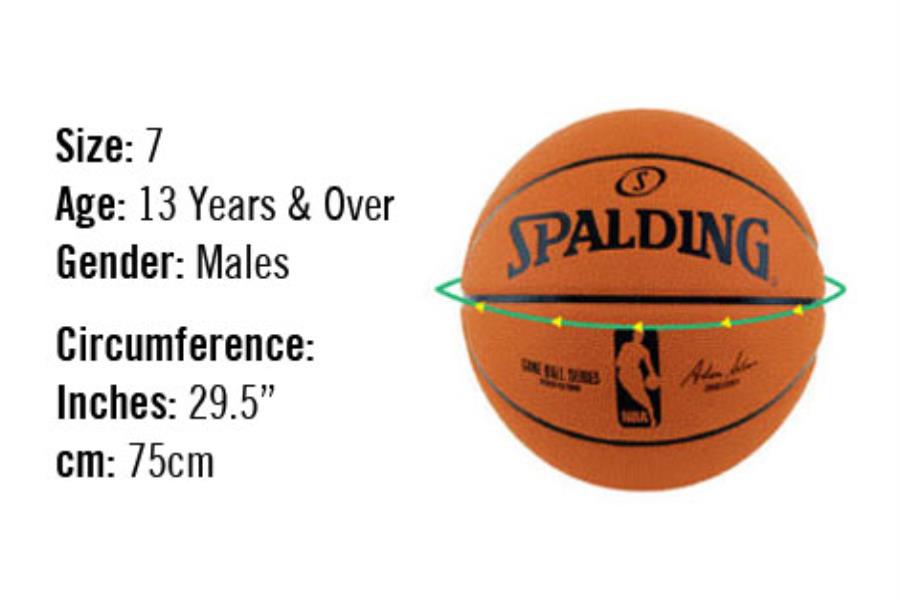
The usual size of men’s basketball is size 7.
Typically, it is not used by younger children unless their family has brought it with them.
Typical specifications:
- Circumference: about 29.5 inches
- Weight: about 22 ounces
- Avoid using: women, girls, and professional women’s basketball players.
Insert Structured Bio Table
For those seeking a quick answer, the following reference table may be helpful.
| Attribute | Youth Basketball Information |
| Topic | Youth basketball size |
| Most common youth size | Size 5 |
| Size 5 circumference | About 27.5 inches |
| Size 5 weight | About 17 ounces |
| Typical Size 5 age | Around 8–11 |
| Smaller option | Size 3 or Size 4 |
| Larger youth option | Size 6 |
| Standard men’s ball | Size 7 |
| Main selection factors | Age, league, hand size, skill level |
| Best starting point | Follow the player’s league specifications |
Physical Appearance Table
The physical properties of a basketball are clearly different between sizes. Here’s a quick comparison.
| Basketball Size | Approx. Circumference | Approx. Weight | Appearance and Handling |
| Size 3 | 22 in | 10–12 oz | Small and easy to hold |
| Size 4 | 25.5 in | 14–16 oz | Compact youth ball |
| Size 5 | 27.5 in | 17 oz | Junior size with good control |
| Size 6 | 28.5 in | 20 oz | Larger ball for older players |
| Size 7 | 29.5 in | 22 oz | Full-size basketball |
However, the gap can be quite small on the page. In child’s hands, it’s larger.
Read Also: USA vs Spain Basketball Match Preview: Rivalry, Key Matchups and Prediction
Why Does Basketball Size Matter For Young Players?
A basketball is more than a ball. It is a learning experience.
Young players must learn a number of skills simultaneously. These include dribbling, passing, catching, shooting, pivoting and ball protection.
If the ball is too large, it can interfere with those skills.
A child might not use their fingertips when dribbling, for instance. They can also alter their shot as the ball becomes “heavy”.
Sometimes, it’s not about the inability. The equipment just doesn’t fit the player.
A proper size ball can assist a young player to:
- Play the ball more easily.
- Practice correct dribbling skills.
- Develop passing skills
- Practice shooting mechanics
- Build confidence
- Improve hand-eye coordination
- Play through rather than against the ball
How To Choose The Right Youth Basketball Size
Age is helpful but shouldn’t be the only criterion.
1. Check the player’s league
If the ball is going to be used for organized basketball, this should be the first step.
Youth leagues may have particular basketball size requirements. A child may drill with one size and play with a different size.
The competition ball can be used for practice to help make transition easier.
2. Consider the player’s age
Age provides a good baseline.
A younger child will probably need a smaller, lighter ball. Older children can slowly progress to bigger size balls.
Two children of the same age, though, can have various hand strength and coordination.
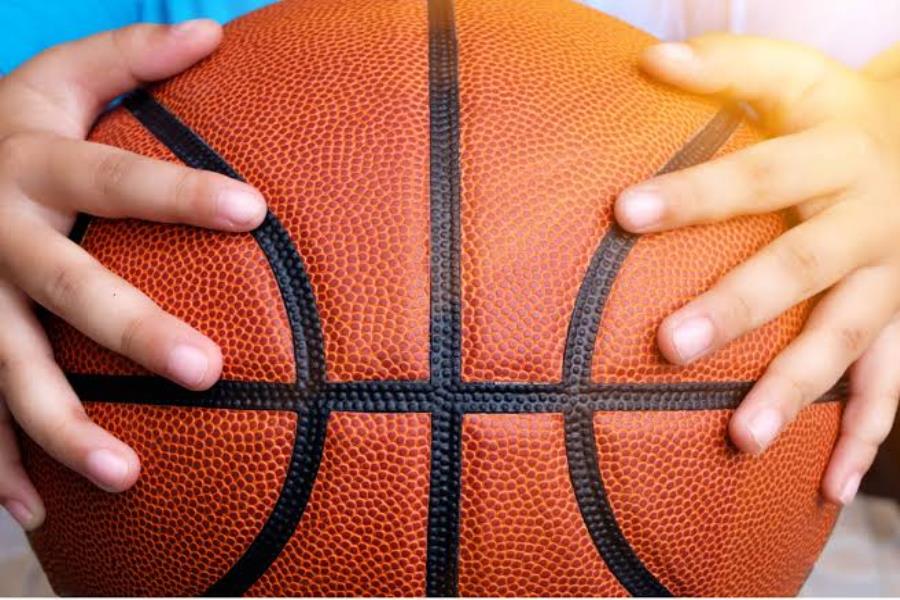
3. Look at hand control
Does the player have good control of and grip the ball?
Ask them to:
- Use both hands to hold the ball.
- Dribble with one hand
- Pass to another person
- Catch the ball squarely
- Try to make a simple shot.
If the ball is consistently slipping from their hands, it might be too big and/or too heavy.
4. Think about skill development
The aim is to get the smallest ball, not just any ball.
The player should eventually grow used to the size they play with in their league.
To aid in learning control, a smaller basketball is used. As their skills improve, a bigger ball can be useful to progress too.
What Size Basketball Should A 7-Year-Old Use?
Generally, a 7 year old will be more comfortable playing on a Size 3 or Size 4 basketball depending on a child’s growth and league regulations.
Some programs start introducing Size 5 at an earlier age. This is why the equipment requirements of the league should come before a general age chart.
A smaller ball may help one gain basic skills with ease for casual practice.
What Size Basketball Should An 8-Year-Old Use?
8-year-old can play with either a size 4 or size 5 ball.
The decision will vary based on the skill level and/or league of the player.
For children who are participating in structured basketball, follow the program’s instruction on the size of the ball to use. If they are practicing at home, select the size at which they can practice and develop to the competition size.
What Size Basketball Should A 10-Year-Old Use?
Generally speaking, a 10-year-old youth basketball player will logically be a size 5 ball.
Players are typically learning more complex skills at this level in dribbling, passing, shooting and moving.
The size 5 basketball is a good introduction between control and basketball practice.
What Size Basketball Should A 12-Year-Old Use?
A 12 year old is allowed to play Size 5 or 6, depending on league rules and level of competition.
This is a time when size may start to differ among programs in basketball.
If he or she decides to play in a league using size 6, it would be wise to practice with size 6. If they are still playing Size 5, then there’s not much of a reason to switch just because they turned a certain age.
Youth Basketball Size vs. Adult Basketball Size
The main difference is the circumference and weight.
The Size 5 youth basketball will be easier to use for a young player than a Size 7 ball.
| Feature | Size 5 | Size 6 | Size 7 |
| Circumference | 27.5 in | 28.5 in | 29.5 in |
| Approx. weight | 17 oz | 20 oz | 22 oz |
| General use | Youth | Older youth/women | Men’s basketball |
| Control for young players | Easier | Moderate | Harder |
Playing with an adult size basketball too early can make some fundamentals more challenging.
But that doesn’t mean players should steer clear of bigger balls. Learning is a process of progression. The important thing is to use the ball that the player is in need of at the moment.
Common Mistakes When Buying A Youth Basketball
It’s easy to fall victim to the wrong ball. These are some of the common pitfalls to avoid.
Choosing based only on age
The age range is a broad guide and not definitive.
Player development is important as well as League rules.
Buying the biggest ball
A larger ball is not necessarily a better ball! Young players should first be controlled, rather than given more size.
Ignoring the playing surface
Different covers can be used on indoor and outdoor basketball.
When playing primarily outdoors, use a ball that is made for outdoor courts.
Buying a cheap ball without checking construction
Price matters. So does durability.
Everyday use requires a basketball to withstand daily play, dribbling and outdoor contact. Considering the cover, grip, seams, bladder, and playing surface.
Net Worth Overview Table: What It Means In Basketball Searches
Net worth is not one of the criteria to determine the size of a basketball. Sometimes, though, the reader will come across articles that feature player profiles as well as equipment information, but are still related to basketball.
To be clear, there’s no relationship between basketball size and the amount of money that a person has.
| Term | Meaning | Connection to Youth Basketball Size |
| Net worth | Estimated value of assets minus liabilities | No direct connection |
| Basketball size | Physical size classification of a basketball | Directly relevant |
| Ball weight | Weight of the basketball | Directly affects handling |
| Circumference | Distance around the basketball | Defines ball size |
| League specification | Official equipment requirement | Can determine which ball to use |
This separation will prevent the combination of irrelevant keywords.
“Youth Basketball Size” Meanings Across Platforms
The meaning of a search term may vary based on its context. Let’s get down to the practicalities.
Meaning Across Platforms With Examples
| Platform | Likely Meaning | Example Search |
| Google Search | General ball-size information | “What is youth basketball size?” |
| YouTube | Demonstration or comparison | “Youth basketball size comparison” |
| Amazon | Product-shopping intent | “Size 5 youth basketball” |
| TikTok | Quick advice or product content | “Best basketball size for kids” |
| User experiences and recommendations | “What basketball size should my 10-year-old use?” | |
| Basketball league website | Official equipment rule | “U10 basketball size requirements” |
| Sports retailer | Product selection | “Junior basketball size 5” |
That’s also one reason why a good basketball size guide should be able to answer more than one question. Users who type in the same term might be looking for different things.
Size 5 Basketball: Is It The Best Youth Choice?
Size 5 is one of the most popular sizes for youth basketball. However, “best” is relative to each player’s age, league and skill level.
When the league calls for Size 5 baseball, it should be obvious that it’s a child’s choice.
If you are a beginner and are playing at home, a smaller ball might be easier to control at first.
Consistency is the key. If the player has got the competition ball size, then regular practice with that size may permit him/her to get a comfortable experience with ball weight and size.
Indoor vs. Outdoor Youth Basketball
The size is just one element of basketball purchasing.
Additionally, it is important to take into account where the player will play the ball.
Most indoor basketballs are manufactured with a softer surface to accommodate the more even surface of the basketball court. They include covers that are designed for indoor play.
Outdoor basketballs must be tough enough to stand up to the asphalt and concrete. Usually they are made of more durable materials.
If the ball is going to be played both inside and out, choose a ball that is designed for both.
How To Tell If A Basketball Is Too Big
There are a number of simple signs.
The player may:
- Have trouble holding the ball.
- Dribble with loss of control
- Use their palm rather than fingers to play
- Have difficulty passing accurately
- Shoot the ball with a push, don’t use a shooting motion.
- Become frustrated during very fundamental drills
The size of the ball is just one indication that it is the wrong size.
However, there are multiple indicators to keep in mind.
How To Tell If A Basketball Is Too Small
It can be the other way around, too.
Switching to the next ball size may be a good challenge if the player is familiar with the small ball but has not yet established control in it.
The player should slowly get used to the greater circumference and weight.
The good sequence could be:
Small youth ball → Size 4 → Size 5 → Size 6 → Size 7
The course of events is different for each player and league.
Read Also: How to Shoot a Basketball Better: Complete Guide to Becoming a More Accurate Shooter
Final Thoughts
There’s no need to search for an intricate formula to determine youth basketball size.
Start with the player’s league requirements. Next, take into account the age, hand control, skill level and intended use of the ball.
In terms of youth basketball sizes, Size 5 is the primary size for many kids. If the person is a young beginner, Size 3 or 4 may be necessary. Older youth players can switch to a size 6 basketball and eventually move on to a size 7 basketball.
The objective is to provide the player with a ball with which he/she can play and to support him/her in making progress towards the ball size he/she will be able to use in competition.
This enhances the productivity of practice. It also allows younger players to spend less time battling with the ball and more time on learning the game.
FAQs:
What size basketball is best for youth?
Size 5 is a common youth basketball size, especially for children around 8–11. Younger players may use Size 3 or Size 4. Older youth players may use Size 6.
What is the standard youth basketball size?
The standard varies by league and age group. Size 5 is widely used for youth basketball and measures approximately 27.5 inches around.
Is a Size 5 basketball for kids?
Yes. Size 5 is commonly designed for youth players. It is smaller and lighter than the Size 7 ball used in men’s basketball.
What size basketball should an 8-year-old use?
An 8-year-old may use Size 4 or Size 5, depending on the league. Check the competition rules before buying.
What size basketball should a 10-year-old use?
A Size 5 basketball is commonly used by 10-year-old players. The player’s league requirements should be the deciding factor.
What size basketball should a 12-year-old use?
A 12-year-old may use Size 5 or Size 6. The correct option depends on the league and competition level.
Is Size 6 or Size 5 better for youth basketball?
Neither size is universally correct. Size 5 is smaller and lighter, while Size 6 is larger and heavier. The appropriate choice depends on the player’s age, league, and skill level.
1 Comments